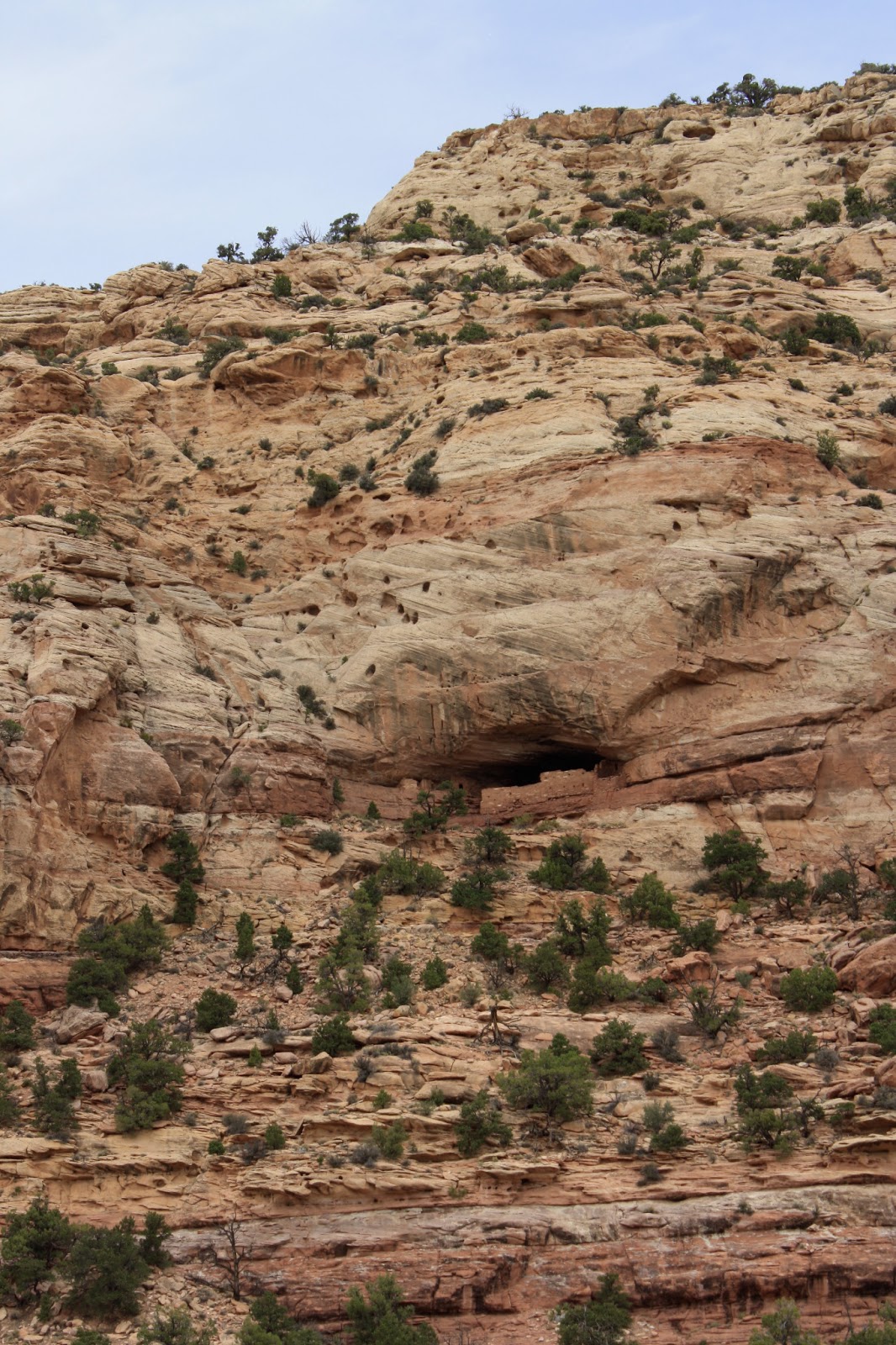
Tucked into southeastern Utah is the Dark Canyon. It is south of Canyonlands National Park and the Needles district, on the east bank of the Colorado River. It is an interesting mix of canyons and federal land management agencies, with the BLM, Forest Service, and Park Service each owning a little bit of the canyon and the surrounding systems.
It is roughly 37 air miles long from the watershed crest at 9055 ft to the downstream end emptying into the southern end of Cataract Canyon at 3740 ft. The watershed of the Dark Canyon alone is roughly 264 square miles and covers approximately 162,000 acres. There are at least a half dozen canyons out at the end of the road, which go in various directions down to the Colorado and are all completely separate from the Dark Canyon system. The end of the road was approximately 82 miles from Blanding, Utah, 81 of which is dirt. This is the beginning of the vacation flora. I think it will take about a decade, at least.
Upcanyon from the Sweet Alice Hills
The light changes.
The road less traveled, heading southwest.
The Henrys, the last named mountains in the US.
Across the woodland to the edge of Youngs Canyon, an access to the canyon bottom.
Looking into Bowdie Canyon, one of the other canyons in the system.
A massive ruin about three hundred feet off the floor of Fable Valley, a north trending canyon that ultimately becomes part of Gypsum Canyon and then down to the Colorado.
View into the heart of Bowdie Canyon.
The heart of Bowdie Canyon (the middle of the shot above), the canyon bottom was not visible and appeared to be a slot canyon that went down several hundred feet.
The exhausted and hot Xochi resting after running and jumping about in a side canyon to Bowdie.
There's a line from the indie pop band Ivy that says, "at the edge of the ocean we can start over again." It's been that way for me, returning to the surrogate natal landscape of the Oregon coast. Of all the wild and amazing places I've gone in my life, I've come back again and again to my aunt's house in Lincoln City. It's a landscape where the ocean is relentless, the cold intensity of the water, the tension of sand underfoot, the roll of fog and clouds as they run into the headlands. It's been a long journey over these last months and I'm here standing and staring, toeing the starting line on the rest of my life. I've come to the edge of the ocean to start over.
The curvature, down the 500 foot drop from Cape Foulweather
There is a journey in every garden. It starts with a blank sad waste of dry bermuda grass, a tiller, and voila you have a garden. But over the years you actually get to know it, to pay attention to not only how the sun falls on the space, but the shift of light through the day after many days of watching and paying attention. Watching cycles of artichoke rise and fall and live to see another season, and another, and another. The cycles of a land trapped within a city, but filled with the city's life. The cooper's hawk that would perch on the fence beside the hens, their nervous clucks. Watching the cooper's hawk chow down in the tree next door, poor dove. There are the coveys of quail that know the cover of the Atriplex bush out front of the house. The whiptail lizards, the scorpion that bit Mona on the paw the first month in the house. This was life. This was home.
We are so lucky to live on the planet for even a short time, so lucky to share in all the relationships, all the beauty, all the wonder. This garden was a journey in and of itself. It was me planting the posts and the fences and the grasses and the tomatoes. It is a journey into the simple question of how do I live here? This was how I interpreted my answer.
The Blank Slate.
February 17, 2010
1.
May 7, 2010
2.
May 15, 2010
3.
May 19, 2010
4.
June 17, 2010
5.
July 8, 2010
6.
August 5, 2010
7.
November 12, 2010
8.
May 11, 2011
9.
November 3, 2012
10.
December 9, 2012
11.
February 14, 2013
12.
May 16, 2013
The end of Buckleyfarmlandia I is nigh. The house went into escrow yesterday. I stand on the fulfilled side of owning a home, knowing full well all the love and effort that resides now within these walls. It is all good work. All of it. Even the hard stuff. This is my final love letter to the Rita Garden House.
The
fence reaches twenty feet in the air here, the eight inch square posts rising
solid out of the gray concrete sixteen feet up, to the four foot plate steel at
the top. Two hundred yards up the line from where I stand the massive rusting
hulk of the wall ends, back to a low vehicle barrier and finally to the tawdry
twist of barbed wire that strings up and over the hill between embedded
t-posts, marking the line. The Line, la linea, the United States-Mexico border.
I see the scrawl instantaneously, at the highest point of the fence, upside
down from my angle. "Diego fue aqui" it reads. Diego was here. In one
instant the steel is torn down, rendered utterly obsolete and foolish,
revealing in a moment the literal absurdity of walling off one country from
another to halt forces much more than the wind of a late summer storm against
the wall. A wall scaled by an immigrant or a smuggler, regardless his name
there to mock the wall.
The wall in all its infinite wisdom
to stem the flow of needs and wants. The solution to the problem of nineteen
foot ladders. I stand at the base of that wall, standing on the deeply eroding
border road at the very end of the Huachuca Mountains, standing on National
Park land, not wondering at all why it was washing away. It was obvious. I was
wondering who in their right mind thought a road straight up the hill, plowed
down to accommodate the heavy machinery necessary for the wall's construction,
who would think it could sustain against the rains of August? Who in their
right mind would think that a taller wall would stop the flow of drugs, or
people, or water?
The economics of the wall ignore the
economics of the soil releasing individual grains into the flow of falling
rain, it ignores the persistent ethos of erosion. It ignores the complexities
of animal migration and pays no attention to the dynamic of fire as it moves
across the grassland, swirling as it does. The economics of the wall are
emblematic of the ignorance of our economics, of our continuing failure to see
that economics means nothing when compared to the sustenance and resilience of
our ecologies. Our modern idiom of economics supports an intellectual structure
for an ideology of utter devastation. The principles of economics continue to
believe only the intellectual models that provide support for its continuing
dominance as a way of organizing the world. Our failing ecological
infrastructure is but an externality.
A beginning economics teacher offers
only the simplest models to his students, arguing they need only evaluate the
simplicities of straight lines and linear relationships. Try to ignore the
externalities, try to ignore the complex interactions of the atmosphere and our
exhaust pipes. Try to ignore the disparity of our cultures and chalk it all up
to the beautiful market, the ever beautiful market. The ever expanding App
Store, the online bazaar, the rising gas prices, the rich buying our elections;
these you must see as natural expressions of the market, the market that makes
the wisest of decisions. The market driving the car toward that cliff up ahead.
Wendell Berry spoke in his recent
Jefferson Lecture of our need of affection for places and the land.
"Without this informed, practical, and practiced affection, the nation and
its economy will conquer and destroy the country." This affection he
forcefully linked to Leopold's Land Ethic to tie us to a larger whole, to
broaden our vision beyond the walls we have built, to see the effects of the market
on the land, to see the externalities and in so doing become a whole people. A
people of this place and of this continent. This was the vision of Leopold in
writing, "a system of conservation based solely on economic self-interest
is hopelessly lopsided."
Our hopelessly economic relationship
to the land provides for a higher valuation of national security over
ecological security. It engenders the philosophy of design driven by straight
lines, like the scar that grows with each passing day as the rain falls and
rocks release their hold and make their way down that fantastically linear
slope. Our hopelessly economic relationship fails to see a Mexican farmer being
able to stay on their land and grow corn of their culture and provide food
security for their communities and border security against the scary hordes of
farmworkers intent on stealing the back breaking work of harvesting our cheap
food. These are the symptoms of economics. These are the symptoms of an
ideology of utter devastation, a system constructed on the rational exhaustion
of each and all resources in its quest for the perfect curve, the linear model
of humans wanting profit.
There is no profit in the flower of
a plant. Except when it supports the life of a pollinator and stabilizes the soil
and supports the mycorrhizal life between its roots. No profit in the flower
when pollinated it transforms sunlight into fruit and a flycatcher snatches a
fly hovering too long near a beautiful bloom and the farmworker reaches down
through the haze of industrial pesticides and picks the food we eat. It is
profit when the middle man steps in, when the market takes hold of the precious
corn, packages it in flashy oil masquerading as plastic, and we suddenly have
food in our brief encounter with the sterile hum of the florescent light of
endless shelves and our courtesy card that tracks our purchase, and there we
have our cheap land ethic.
This unwillingness to see that it
takes thought to produce better food, that food doesn't come from the
supermarket, it is the same unwillingness that drives the growing scar cutting
deeper beside the border wall. It is a scar of our own making and it is a scar
on our own side. As though our own self-revulsion of knowing we know better, of
knowing that wall is not the way to engage the world. The simplicity of an
economic way of life is in its ability to convince us to ignore all the
elements that actually matter in the construction of the model. The ever
interchangeable producer and the ever interchangeable consumer as measured
against each other to a vanishing point.
The theory of economics is
predicated on the rational exhaustion of all possible resources. It is our
undoing as a species. Unless there is an ethical restraint, an understanding of
the importance found in beauty, joy, wonder, and especially affection for the
natural world beyond economics, then Homo
sapiens sapiens will not prove so wise wise after all. It is in the
manifestation of the land ethic, in the understanding that we must make human
culture responsive to the needs of the land in order to survive. The late
author of the brilliant novel Ecotopia, Ernest Callenbach, had a way of putting
our dilemma into words. "Taking care of each other is one practical step
at a time, most of them requiring help from at least one other person; survival
is a team sport."
I would add that we need desperately
the help of the pollinator and the soil microbe. We need the absorptive
capacity of every bit of organic material in our soils. We need the radical
diversity of our human family as much as we need the radical diversity of our
agricultural seed collections in order to grow all the food we are going to
need in the places we are going to need it. We need the complex diversity that
is the flora and fauna of our home ranges, and we need the attitude of mind
that it is all essential. Like the tinkerer of Leopold, who keeps meticulous
track of all the parts, we must pay attention to the diminishing world around
us while simultaneously coaxing it back to its previous stability, resilience,
and diversity.
Reaching back to needs and wants and
we are back to economics at root. Economics says there are no needs beyond air
and water. There is no room for the life or the soul of the soil. Back to
economy, as Wendell Berry explains as "the making of the human household
upon the earth: the arts of adapting kindly the many human households to the
earth's many ecosystems and human neighborhoods." We are back to staring
again at the wall. Staring again to the simple words there upon the crest of
the multimillion dollar rusting core of our relationship to the land.
"Diego fue aqui", Diego was here. We see an arm snaking up and over
the wall, struggling to hold on with one hand and scrawl with the other. A
simple act of breaking down the wall. A simple act of reminder, as Berry would
have it. "We do not have to live as if we are alone."
Back from the Gila, a brief trip to the heart of the Miller Fire of 2011, downstream of 297,845 acres in the Whitewater Baldy complex of 2012. The sky was finally blue, rinsed by the rain of the night before. The first rain of the season. It was gentle and hard at the same time. It was building again as we drove home to Tucson.
Xochi was bitten by another dog really hard at the dog park on Thursday, hence the reason I am home. She is recovering but making me believe in resilience. She is a strong dog with a terrible wound on her side that had to be surgically repaired. The parallels at seeing the resilience in the headwaters of the Gila and seeing Xochi delicately hop for joy with stitches in her side, helps me believe in resilience.
I laughed to myself looking at the date and the last sentence of my last post...May 14th, "I'm going to get some more time in the garden between field work stints." Right. Instead it has been trip after trip after trip after trip...there was that month in July where I stayed home, then that head injury in Mexico thing...and then back in the field. Again. Again. Again. Got to see a lot of territory and a lot of beautiful plants and landscapes, some recovering immediately from fire, some dry in a three-year drought, and even some with rain. Here are some of the panoramas I've been working on, I'll work backward from the present so you can see where I've been.
Big Bend National Park, Texas: I got asked to go with the Chihuhuan Desert Network crew to sample some tinajas (persistent pools of water in stone basins) for eight days in early November. The trip was into an area in the extreme western portion of the park called Mesa de Anguilla. We had a pack train that carried a lot of our gear in, which made for a pretty luxurious backcountry trip, and got to hike about 25-30 miles around this really beautiful place. Here are some highlights:
Morning of our first day in Big Bend, sunrise lighting the Chisos Mountains. Wow.
This is our campsite. We didn't see anyone for six days outside of a group of border patrol agents on the first day right near the trailhead. This is Joseph and our mules making my back feel so so much better.
This is a view of Bruja Canyon, if you move right to left upcanyon...in the distance the mountains on the right are the Chisos Mountains about fifteen air miles away. We hiked from the middle of the image all the way out to the left.
This is looking down Bruja Canyon, in the photo above, this is the portion of the canyon that is on the right half, this is what it looks like from the rim of the canyon.
This is the way to get from the top photo to the bottom photo in Bruja Canyon. No, there are not really trails, and yes that is my co-worker in the photo... Hiking in upper Bruja we ran across this full Nautilus fossil, which is about eight inches across and like 120 million years old. A couple days later we hiked to a place called Tinaja Rana, this is a photo stitch of about seven photos, but it gives you a sense of how shear the limestone cliffs and how sketchy all the climbs down to check out the tinajas actually were...needless to say we didn't get into this one... The last full day in the backcountry a really rare low front went right over us. Rare because it has not really rained in West Texas in something like three years. We didn't get much beyond slick rock that was treacherous to walk on and a beautiful smell of parched desert rain. The storm as it rolled in... Then we woke to the most crystalline blue sky.
Our last evening we came out of the backcountry and went to a campsite that was directly north of the Chisos Mountains where the sun setting was really that red.
Big Bend is way out there. The nearest major city is El Paso, 360+ miles away. It is in a county the size of Maryland (Brewster) and there are about 9,000 people in the entire county. The nearest town of any size is Alpine with like 6,000? You look out into Chihuahua to the south and there is nothing there either. You are way out there. It is like the Grand Canyon in its vistas but it is just so far out there. The last night we were there I could see the Crab Nebula with the naked eye, along with so so many meteors from the Leonids. There were huge ones and even the most delicate wisps of green and red light, so minor you would never see them if you weren't in Big Bend. So dark and so clear. Beautiful. And then there are the plants.
Like Hechtia texensis, in the Pineapple family. There were a few beautiful plants blooming, eight flowers in total over the entire time. It is a little dry out there. But I was reminded of how magnificent the planet is and how remarkable all these evolutionary wonders are and how much I really really like botany. Ariocarpus fissuratus, known as living rock because it looks like a rock. The plant is three inches across and disappears under the ground when there is a drought. This is the only flower we saw of it, which always blooms in November. The flower is about 1.5 inches across. You usually step on the plant before you see it is there...
It is generally curious to me that the seasonality of growing food in the desert is so terribly off from everywhere else I've grown. By that, I mean the ability to more or less continually maintain a garden throughout the year with appropriate crop selection. It makes for a really enjoyable winter season when everything else is dead. It really throws you off, especially when you have essentially three growing seasons a year. You plant in early spring, the monsoons, and late fall. And if you don't have a deep freeze you start harvesting in February from the late fall, late May from the early spring, and then October from the monsoon planting, a rolling bounty. Now that the soil is finally getting repaired and I've had a chance to cover crop and get a lot of organic matter in the soil it is beginning to show signs of life. Growing without any pesticides or herbicides requires patience, it is a really slow process of building up the system's resilience.
But as I discovered this year, the deep freezes happen in La Nina years, and not only do they hit the sensitive annual crops, they hammer the trees too. The toll from this year: both Mexican limes died, the Tangelo is now less than a foot tall and resprouting, the entire eleven foot lemon dropped its leaves and is now struggling at four feet but resprouting throughout and I saw flower buds on it today. The grapefruit/blood orange is also a foot tall, but resprouting. The pomegranate? Totally fine. Going to plant a lot more of those, easy to deal with. Citrus is a weenie tree: at least the lemons and limes are. Even lost a mesquite in the center of the garden. Guess it's time to replace that one too. Here's a simple annual shot comparison to show where the garden has come in a year. Here's the link to the original post of pictures from the beginning to August last year for reference. The first is one of my first panoramas taken on May 7, 2010. The second is taken on May 11, 2011. And so it grows...
May 7, 2010
May 11, 2011
Roster of what's in the ground for this year: Tomatoes: San Marzano romas, Oaxacan Pink, Thai Pink Egg, Punta Banda Carrots: Scarlet and Belgian White Tohono O'odham yellow meated watermelon Satsuki Midori cucumbers Tepary beans Uncle Joe's basil Mrs. Burns lemon basil Fordhook zucchini Hopi Melon Lacinato kale Hopi white posole corn fennel I'itoi onions parsley chiltipines Yankee Red Bell peppers Nambe green chile Texas Hill country red okra celosia Mexican saffron: Azufran Pima brown lentils (admittedly struggling this late) Pulpa de Milpa tomatillo potato (single volunteer) dill San Juan dipper gourd
So we'll see how this goes...Stay tuned, now that schools out and I'm getting the ability to breathe back after my pneumonia, I'm going to get some more time in the garden between field work stints.